Showing posts sorted by relevance for query paint cabinets. Sort by date Show all posts

One Room Challenge–Week 3

Hey hey!  It’s week T H R E E of theORC
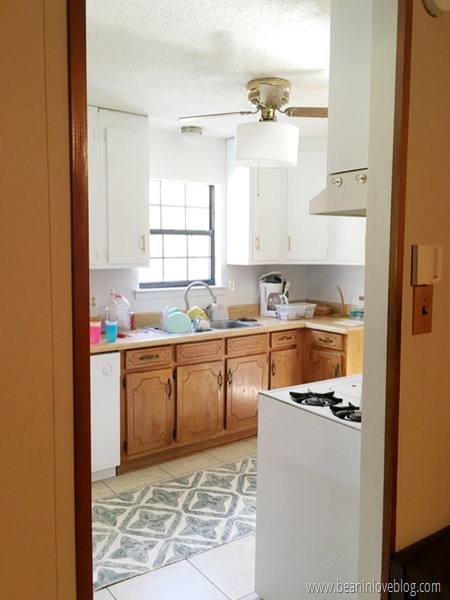
and over here, things are looking UP!!  No really, they are.  I got all of the upper cabinets painted this week and, oh my, it is CRAZY how much more light bounces through what I already thought was a fairly bright kitchen!

Check this out:IMG_7417


And then take a look at the same area pre-move:IMG_6824
The Almighty said it best with “Let there be light!”  Have you ever gone white in the kitchen (or any room really) and experienced the added light?  It’s great, right? 

I’ve written a few posts on how I paint cabinets in the past and time around the paint can wasn’t much different in the way of technique but I did use a new-to-us paint than I have in the past and got a little smarter as far as set-up goes.


More Painted Kitchen Cabinets...That Didn't Turn Out

 In case you were wondering, it takes about 193 steps to get from here:


to here:


Our Painted [Upper] Kitchen Cabinets

I've painted a thousand cabinets, ok, maybe not thousands...let's see - four kitchens now, four bathrooms, and more dressers and pieces of furniture than I can count - and each time, I've done things a little differently.  Each time, I learn a more efficient way, or a better way to get a smooth finish, or I use a new paint.  So I can't say that I have an ironclad, tried-and-true method to painting cabinets but I can say that I've had great success in the arena.  The same story follows the most recent endeavor of painting our current upper cabinets in the kitchen.

First, I removed all of the doors and the contents of the cabinets.


I wanted to replace the old cabinet pulls with new knobs so the next thing we had to do was fill in the old hardware holes and drill new holes.

The Case for Matching Hinges to Cabinet Color

I've become very passionate about something.  It started out as something I tried in our first house down south years ago and since then, I've done it a few more times and I now won't ever deviate from not doing it.  It's maybe a small matter in the grand scheme of painting cabinets but I feel like it's not so small in the impact it makes.  

Hinges.  Specifically, like it gives away in this post's title, matching the color of your hinges to the color of your cabinets.  I know that these days, most cabinets are made with hidden hinges so this is a moot point for most truly modern kitchens but if you've got old cabinets that you're hankering to paint or have already painted, take note.  You might agree with me and you might not but here's my argument...

If you're doing a little kitchen makeover (or bathroom...or anywhere there are cabinets that could use a fresh coat of paint to modernize them), it's only natural to then replace the old hardware on them with new.  New pulls and knobs go a long way in updating cabinets.  You might even go a little farther and want to replace the hinges on the cabinets to match that pretty new hardware.  Makes sense.  It's logical.  But here's where things could go two ways.  You could get new hinges that match the hardware - you know, brushed nickel hinges to go with your new brushed nickel hardware -  OR you could scrap that idea and either buy hinges that match the paint or paint them to match.  If the color you're going with is black or white, you probably won't have the hardest time finding new hinges in those generic colors, making the switch fairly simple.  But, if you're going with the latest trend of green, blue, tan, etc...you'll probably end up having to paint your hinges.  Lucky for you, you can pretty much find every color of spray paint on the planet these days so finding a match may not be that difficult.  (I'd recommend this primer* first though along with several light coats.  Opening and closing the hinges between coats also helps them not to stick in the process.)

Do I sound crazy?  Or are you smelling what I'm cooking?  Let me give you a few examples...this is the fun part.  This whole idea of mine started here in our master bathroom back in our second house (click here to get a whole tour): 


It's hard to tell at this angle but it was the best I could find.  Can you spot the hinges?  They're the same color as the cabinets.  They're definitely not invisible but they don't stand out like a sore thumb either.

3 P's - A Tutorial On Painting Cabinets

Prepping, Priming, and Painting...the three important things you need remember and to stick to when revamping cabinets.  This past week I spent about two hours a day working through each of these P's to get the sleek lookin' master bathroom cabies we've got right now.  In this post, I'll go through the hows, whats, whys, and even wheres in case anyone else feels the motivation to take on some cabinets.  :)


 Process Numero Uno:  Prepping
Step 1:  Remove all doors and drawers, hinges and hardware.
Step 2:  Sand.
Our cabinets had a dull-with-time polyurethane coat on them that had to be removed before any priming and painting was to begin to ensure the best adhesion.  To remove said coat, I sanded down each drawer and door until the sheen was gone.  I took it outside so that I didn't have to worry about sawdust making it's home in our casa.  I must also mention how blessed we are to have friends who let us borrow this beauty of an electric palm sander, saving my hands and arms from back and forth sanding doom.  
Using medium grit sandpaper, I quickly went over each piece, making sure I sanded just enough to take off the dull sheen of poly.  I also made sure to sand both the fronts and backs.  I thought I'd have to do another once-over with a light grit sandpaper, but found that after the medium grit, the cabinets were as smooth as babies cheeks, so I skipped that step.  To sand inside the routed square, my fingers and some sand paper were the best option since the electric sander wouldn't quite fit. 

Step 3:  Clean.
After the entire piece I was working on was smooth and poly-free, I simply brushed off the sawdust and wiped it down with a damp cloth, then moved on to the next piece.

Doors and drawers down, frame to go.

Step 4:  Sand the cabinet frame.
The process of removing the poly from the frame was very similar, however, there was no way of doing it outside.  For this step, I simply attached the sawdust canister to the palm sander and went to town.  (Side note:  If you're using a plain sheet of sandpaper without holes like I did, you need to make sure you punch holes into the sandpaper once it's attached equivalent to where the holes on your palm sander are to make sure that the sawdust is sucked up and into the canister.  I simply attached the sandpaper and poked the end  of a scissors through the paper into the holes.)  After a quick sanding and wipe-down, the frame was ready to go:

Step 4:  Tape.
After laying out each door and drawer in our living room (a.k.a. workshop) atop a bed of old sheets to protect the floors from dripping, I completed the last step in the prepping process - taping.  I wanted clean lines around the backs of each drawer so I just stuck a layer of masking tape around the edges like so:


Process Numero Dos:  Priming

Step 1:  Oil-based primer.
To make sure no stains would seep through the finished paint, I first applied a thin layer of oil-based primer (Kilz), which is awesome at preventing stains.  Because I'm lazy mineral spirits (what you have to use to clean up oil-based anything) intimidate me, not to mention that we just don't have any, I used a sponge brush to apply this layer and then threw it away when I was finished.  :)
Here's what the frame looked like after this step:

Step 2:  Water-based primer.
This step really is optional, but I've found that applying two coats of primer means that you usually only need to apply one coat of paint instead of two or more, especially when you're dealing with going from dark to light (in this case, wood to white paint).  I already had the stain-blocking layer of oil-based so for my second coat, I opted for Bulls Eye water-based primer from Lowe's.  I used a paint brush (2 inch) to get into hard-to-reach-with-a-roller areas like the backs of the drawers:

and crevices and corners of the frame:

Then, to prime the flat surfaces I used a small foam roller in order to get the smoothest application.

(Important side note:  You can paint water-based over oil-based but you CANNOT/SHOULD NOT/BETTER NOT paint oil-based over water-based!)


Process Numero Tres:  Painting

This step flows exactly like the priming step - brush for corners and crevices, foam roller for flat surfaces.  For both instances, this was the timeline I worked along:
1.  Paint backs of drawers with brush.
2.  Paint corners and crevices of frame with brush.
3.  Wash brush.
4.  Paint backs of doors with foam roller.
5.  Paint drawer fronts with foam roller.
6.  Paint frame's flat surfaces with foam roller.
7.  Making sure door backs are dry, flip doors over and paint fronts with foam roller.
8.  Wash foam roller and done!
Why such a strict process?  I value my brushes and hate when paint dries on them so I painted all areas requiring a brush first.  Also, when rolling, I painted the door backs first,  painted everything else, then painted the door fronts.  This gave the backs time to dry (around 45 minutes) before I had to flip them over and paint the fronts.  The color I used is called "Promenade" by Valspar.  It's an almost pure white but without the glare white can sometimes give off.

While I was waiting for the paint to dry, I also took a little bit of time to spray paint the door hinges, which were brass, with Krylon's oil-rubbed bronze.  I painted the door handles a few months ago but hadn't yet gotten to the hinges.  (I might also mention that if it was up to me, I'd have bought new ones but Anthony really likes the current ones and didn't want to dish out dough for new ones (even though I ensured him I could find some on clearance) and I really love him so...)  If you're interested in doing this, know that it doesn't affect the workings of the hinges one bit and they look like they were bought that way.  A couple of light coats should do the trick and don't forget the paint the screw tops to match!  :) 

Step 5:  Clean and Organize (my last but completely optional ,unless you're semi-OCD like me, step).
I can't put dirty things (not that anything in our bathroom was really "dirty") into shiny new things.  In other words, I couldn't put plastic baskets, toiletries, and other bathroom stuff into newly painted and clean cabinets.  So, I organized every space and cleaned every bottle and basket.  Just for kicks, here's some before and after of just underneath the sinks to illustrate my need to have order.

Under my sink before:
Yeah, a mess and a lot of it.  But before you go reporting me to "Hoarders" let me tell ya, I haven't had to buy lotion, body wash, or perfume since high school.

After:
More organized after I found some stacking baskets at JoAnn's for 70% off and vowed to start using body spray and lotion more often.

Under Anthony's sink:
 Clearly not as bad as my side - men require less maintenance, right - but still unkempt.

After:
After adding a helper shelf and creating neat little rows of bottles.

Now that I've gone maybe a little over the top in revealing our personal lives via pictures of what's inside our cabinets, I'll coyly get on with it and show you what you're really interested in - the finished cabinet product.

In the past month we've gone from this...

to this...

...and the best part is that we're just half-way done.  (To read about the tile we installed, click here.)  Up and coming we've got possible countertop ideas floating around, paint to slap onto the walls, and some decorating that will bring our bathroom into 2011.  Anywho, that's another day, another few posts.  Off we go to work on something else on this beautiful Saturday.  Have a great weekend! 

Sandpaper, Nails, and a Mask

Finally!  After living without the oh-so-necessary-these-days internet for a week and getting a run around from our service provider, our web is finally back up and Bean In Love is back in business!  Oh happy Saturday!

As you might know, we've started another project to bring our kitchen out of the dark into the light.  We've already picked out and ordered new countertops so the next step is to get started on re-painting the cabinets.  When we first moved in, we had the great idea to paint the cabinets a chocolate brown using left-over/free paint from our previous house (see here).  Well, it was all great and dandy and looked pretty good when we were done but for some reason the paint remained a little sticky, even to this day.  One cabinet door also had lots of little pieces of roller lint plastered underneath the paint, leftover from the previous owners paint job and it always irked us.  So after we painted our master bath cabinets and fell in love with their look, we decided to carry it into the kitchen as well.  This is the story of how I, during my 16th week of pregnancy with twins, began this somewhat large project while Anthony helped here and there in between work and studying for a masters' exam.  :)

   With our countertops due in on the 17th of this month, I decided to complete the upper cabinets first before they arrived so that I didn't have to worry about accidentally ruining brand new tops with endless piles of paint chips and sawdust and 'oops' drops of primer and paint.  So it began with the upper left side:
 

For starters, I removed all of the doors and hardware and then removed everything from inside the cabinets.

Starting with the doors (the easy part), I set up a workstation outside and got to sanding, first with a coarse-grit sandpaper and then with a medium-grit until all sides were as smooth as two babies bottoms.  :)
Before:

After:
Since I was just going to paint right over them again, I didn't sand all the way down to the wood.  I just sanded enough to make sure that I had a non-sticky, smooth, flat surface to apply primer and paint to. 

To get in the grooves on the edge of the doors and inside the decorative routing on the fronts, I wrapped some sand paper around the thin, rounded end of Anthony's grill brush and went to town.
Then, a probably unnecessary step but just for good measure, I quickly rubbed each door down with a thin layer of Crown Liquid Deglosser NEXT (from Lowe's) to further ensure a good paint stick.

Then, it was on to the cabinet frames where I employed the same sanding process.

Just for kicks, here's a quick, all-around view of other happenings in the kitchen:
Me - prepped, pregnant, and fully protected.  :)

And, the new tablescape I created:
Lovely, innit?

Anyway, back to the cabinets.  After a couple days of sanding, sore arms, and lots of pregnancy bathroom breaks, I was ready to prime.

And that was that.  Except you quick ones might've also noticed one tiny thing missing...
The gaudy scalloped edge above the sink (if you thought "the light bulb", I'll count that too)!  Hooray for 2012 and modern design people! 

How'd I get it down?  Well, after noticing it appeared to be attached with two screws on each side...
...I simply removed them and tried my hardest (without Anthony's knowledge or approval) to bang, pull, and rip it down but to no avail.

It wasn't until my sweet, unknowing husband came home that night that he noticed my apparent deviousness and hesitantly removed it for me - after removing molding from behind and ripping it from six unseen nails from above (no wonder!) - and thereby exposing the ugly baby florescent light we've got goin' on.  But it's okay, we've got plans for that thing and they don't involve keeping it.  Stay tuned!  :)
.           .           .

Well, I'm off to start painting and eating, painting and eating (and scouting for the mail man who just might have my Gap maternity jeans in his possession).  Have a great weekend everyone! 

Our Kitchen - Before & After

I almost called this a "Reveal" but we're waiting to get some cabinet doors made to fit over where the old wall oven used to go and there a couple of other tweaks that we want to happen so revealing our finished kitchen I am not, but I am here to show you how far we've come in five years.

Spoiler alert:  Things have CHANGED.  Big time. 

This was move-in day:

And this was last week:

Hardware Swap

Sometimes I get this wild hair to do something and I have to do it rightthisminute.  Those wild hairs have really been rare since having kids but last week told a different story.  After seeing John and Sherry’s amazing kitchen renovation, we needed new hardware on our kitchen cabinets….okay, wanted…wanted knew hardware.  I loved how they placed knobs on their upper cabinets and coordinating handles on their lower and our kitchen was begging for it.

So, last week I plucked that wild hair and replaced all of our hardware with new, more modern handles on the bottom cabinets and coordinating knobs on the top.

IMG_8424
Our old pulls weren’t bad and truth be told, they were actually pretty nice as seen in these old pictures:
sept122012048_thumb1
jan202012 003
But, they were definitely a little more traditional than the new bar pulls I bought and I thought adding modern pulls would make our refurbished kitchen look a little more modern; not like the old kitchen it is that we set new appliances in and painted cabinets to make it look new.

Old on the left; new on the right:
IMG_1699

IMG_8428
Replacing the lower cabinet hardware was easy peasy.  All I had to do was remove the old and install the new in the same holes.  The uppers were a different story.  I had to remove the old pulls, fill in the holes they left behind, drill new knob holes, and then screw in the new knobs.  On top of all that though, I figured it was high time I touched up the paint on our cabinets.  After almost five years, there were a few places where the paint was chipped just from normal, everyday use.  It was a simple fix though.  I just washed down all of the cabinets (something that also needed to be done) and used a small artists’ paint brush and leftover paint to paint right over those small chips. 

IMG_8427
IMG_8431
Once everything was painted, I got to work filling and drilling for the knobs.  To fill the holes in, I used Bondo (purchased on Amazon because it was cheaper there than at Lowe’s) after seeing Chelsea use it to repair her dining chairs.  The stuff is great and perfect if you’re like me and want immediate results.  It dries super quick!  I filled the holes, sanded them down, and had them covered in paint in under a half hour.  The one thing I didn’t do though was pay attention to detail.  I replaced all of the hardware in sections over four days time and everytime I had a chance to get to work, it was a small chunk of time while the kids were playing or Gianna was taking a cat nap.  So, I rushed and I shouldn’t have because there are places where I didn’t spend enough time sanding the Bondo so that it was completely flush with the door and other places where I should’ve went back and added more, like on this door:
IMG_8436Can you see those two small indentations right where the old pulls were installed?  *sigh*  Lesson learned:  Don’t rush through a project.  I’ll probably go back over and sand or re-fill the next time our cabinets need a touch-up and thanfully, the imperfections aren’t all that noticeable but the fact remains, they are there and I shouldn’t have rushed.  My OCD self will suffer everytime she sees them…

Anyway, lets get to the best part of this little project.  It will end up costing me a few bucks or even be FREE!  How?  Well, because we’re going to sell the old hardware for what we paid for the new – just under $25 for 23 pieces.  The old hardware is still sold at our local Lowe’s for $3 a pop and we bought the new at a fantastic price from the same place I bought the hardware for the kids’ play kitcheneBay!  The knobs cost us 99 cents a piece and the pulls were $1.39 a piece – a fraction of what you’ll find them at in your local hardware store.  And, we can attest to their quality.  They’re heavy, brushed metal pieces of hardware that I’m sure will last just as long as the ones in-store. 
     IMG_8438
IMG_8439

If you have a hankering to replace hardware (or if you didn’t before, maybe you do now!), we highly recommend these! 

IMG_8422
Maybe it’s just me enjoying the change, but it kind of amazing how much of a difference hardware can make in a space.  We have original-to-the-house, ugly pulls on our master bath cabinets and I can’t wait to swap those out for these too.  Of course there’s a whole laundry list of updates we want to do in there eventually so you’ll have to stay tuned for those.  ;)

On another note relating to bathroom hardware, do you think it should match what’s in your kitchen?  I’ve seen lots of HGTV remodels where they install the same throughout the house.  Or is it better that it just coordinates?  Or maybe it doesn’t really matter at all and they can all be different and as long as they go with the rest of the decor in that particular room.  What say you fine readers?  I’m kind of asking because we were thinking of grabbing matching pulls for our bathroom, but in brass since a lot of the fixtures might be heading down the brass route.  Should we stick with the same or go different?  Of course this will all be happening months from now but it’s never too early to get a head start with plans, right?  :)

TGIF!

.           .           .

P.S.  I’m sorry this isn’t more of a tutorial!  We’ve been slowly tackling a lot of boring things around here like hemming Anthony’s pants, fixing broken toys and books, and doing an entire house purge so I didn’t have a lot of time to document this whole process while it was happening.  Let me know if you have any questions and I’ll be sure to answer them!

*affiliate links included in post*

Making Granite Out of Laminate

Since the beginning of our master bathroom mini-makeover, seen herehere, and here, we've been tossing around ideas in regards to replacing the dated, cream-colored, laminate countertops.  After shopping around and realizing that nothing we could buy in a store would fit in our budget (or be worth the investment in this house, with this market), we thought we were on track to create some concrete countertops, and then Tuscan Accents from Lowe's came into the picture.  Tuscan Accents is a line of paint products made to give your walls a sort of Italian charm using two different kinds of paint - one as a base and one as a top coat with a cool spotty effect achieved by using a stippling brush to dab on paint, waiting for the paint to semi-dry, and then wiping excess paint from the surface.  You can read more about it and see some examples by clicking here.  We, on the other hand, took the idea to our countertops, thinking that we'd conduct a little painting experiment - if it didn't work, we had the concrete to fall back on and if it did, well, we'd be two happy little jumping beans.  :)

When we decided to paint our tops, we actually toyed with two different techniques before we chose the Tuscan Accents route.  The other idea was to use a spray paint with a stone-looking effect.  So, to decide which idea would win, I tried out both on a piece of backsplash we removed the week before.  First, I primed the entire piece with a spray primer - Rustoleum's White.  Then I went to work using some leftover paint from our living room.  Here's what it looked like when I was done (with a little photoshopping for results sake):       
1 - Stone spray paint - a no go.  We weren't crazy about the colors - speckled ivory with a sort of greeny-beige - and couldn't find another color we liked.
2 -  Tuscan Accents with a semi-gloss white base - I liked it, Anthony didn't.  The lines between the dried, stuck on paint and the wiped off paint were very obvious.
3 - Tuscan Accents with the white primer as the base coat - nope.  I put too much paint on here so that when I wiped the excess off several minutes later, most of the paint was still wet and therefore came off leaving large splotches.  It really wasn't bad but in the end we liked...
4 - Tuscan Accents with the white primer as the base coat - winner, winner, chicken dinner!  Just the right amount of paint was dabbed on, left to dry, and wiped off to create this look.
5 - Tuscan Accents with the white primer as the base coat - nada.  This was actually my first attempt at the Tuscan Accents but I didn't wait long enough to let some paint dry and it ended up just looking like one big smear. 

So, after we decided on #4, I applied a glossy polycrylic finish (more on that later) over the area make sure it wouldn't yellow the TA finish and to see the look of it.  It worked great.  Then came the real test.  I pulled out my curling iron and straightener to test the durability of the future bathroom countertops, thinking they would be it's biggest ransackers.  It passed with flying colors!  Even though the surface became pretty hot after I left the straightener sit on it (on it's highest setting for 10 minutes), the surface was unscathed!  So anyway, on to the good stuff after I just rambled on for about a million words to set the stage...


First, we prepped by removing the sinks and covering all surrounding areas (thank you Catholic Weekly) since we'd be using the same spray primer as on the test strip.

Then I took a hand sander to the top to remove any sheen and build-up and to create a surface the primer would stick to.

After wiping any and all residue caused by sanding, we were ready to prime.  We made sure the window was wide open and even set a box fan in it, blowing any fumes outside.  While I sprayed, Anthony held a large piece of cardboard underneath the front lip of the top to protect the cabinets.  Here it is, all primed and ready to go:

Next up - painting or should I say, stippling.  I mentioned above that the TA look is achieved by dabbing on paint with a stippling brush.  They sell the brush at Lowe's for 20 bucks.  But, I wasn't going to spend 20 bucks for it considering it was basically a glorified scrub brush.  On the tester strip I 'tested' with a scrub brush we had on hand and it worked wonderfully, so why not continue using that same scrub brush, right?  It saved us $20 and now can brag that it's multi-purpose - "for all of your cleaning and painting needs".  :)  
All I did was dip the brush into a tupperware dish filled with paint and dabbed it onto the top.  I worked in sections, dabbing one section, waiting 17 minutes for it to dry, wiping excess paint, then moving on to the next section.  It was hard to get good pictures of the process as the paint we decided on was so light, but I tried... 

Waiting for it to dry:

Right before wiping (see how some of the paint is dry and some is shiny and wet?):

(Side note:  I might be worth mentioning that to wipe, I used an old, cut up t-shirt of Anthony's and also used a fresh, dry piece for each section.)

To do the front face of the tops, Anthony ran a line of tape underneath the lip to protect our freshly painted cabinets:

Here it is, all painted and ready for poly:


For added protection and to achieve the glossy sheen we were looking for we used Minwax Polycrylic.  After searching "painted laminate countertops" on Pinterest, we decided to go with the popularly used, non-yellowing polycrylic over epoxy ($$$) and polyurethane (yellows).  Using our best paint brush, I painted on seven coats over three days, leaving at least 2 hours of drying time in between each coat.  I also lightly (and I mean lightly) sanded down each coat before painting on the next because the poly directions said to and to get a smooth surface (in the beginning, the paint was a little bumpy so sanding each coat eventually leveled the top out).

This is after two coats of poly:

And this is after the lucky seven coats:


We are SO happy we decided to take the painting route.  You'd have to see it for yourself, but we honestly think that you'd have to take a second glance to realize it wasn't quartz or granite.  As for what it cost us:
Primer - already had
Paint - sample size at $3
Scrub brush - already had  :)
Polycrylic - $16.50 at Wal-Mart (cheaper than the same stuff at Lowe's) and we only used about half of the can bringing the total down to $9 
Paint brush - already had
Grand Total = $12

Some other possibly pertinent information:
1.  Our countertop is 18 square feet.
2.  The paint color we used for the top coat is called 'Oatlands Subtle Taupe' by Valspar.  (I had them add only 75% of the color at Lowes so that it was a little lighter but then added more white at home so really it's a custom light grayish-tan color.)

[Three years later, the countertops are still doing good!  Read the update post here!]

Anyway, I feel like I just wrote another ba-jillion word post about diy but I hope you enjoyed our little, muy successful painting experiment!  As I type these last few words, Anthony is putting the sinks back in (muttering "I hate plumbing" under his breath) so I'm gonna skidaddle and help him and then I'm off to play hair dresser and make-up artist for the day for some teens as Homecoming is this eve.  :)  Have a great weekend everybody!  I'll be back next weekend with more diy craziness!

.           .           .

P to the S:  If anyone has taken on the task of revamping their laminate countertops with paint, please send us pics and tell us how they've fared so far!  We'd love to hear from other peeps who are as paint crazy as us!  If you're contemplating it, we encourage you to take the leap...and then send us your pics!