Showing posts with label Our Master Bedroom. Show all posts

Headboard Retrofit

Annnnnd we’re back with the last step in the making of our new, luxe headboard.  Get all the details on the tufting here and see how we made the arms here.  Pretend that it hasn’t taken me weeks to pound all these out for you and we’ll be well on our way to a harmonious and constructive blogger/reader relationship based on mutual trust and understanding.  ;)

Right after we got hitched, we made our way down the road from our new house to our favorite thrift store in Steubenville, Ohio where we found and purchased a new-to-us bedroom set.  We paid $100 for the solid wood four-post bed, long dresser, and tall dresser.  It wasn’t exactly the style I would’ve picked up new at the store but we needed something and our teeny, newlywed budget loved this set.

I know it’s hard to see the entire thing with all those pillows in the way but here’s what the bed used to look like and what it looks like now after we retrofit the new headboard right over the old:
headboardbna

“How?”, you might ask.  Well, let me tell you.  Quick though because all the kids are apt to wake up in the next half hour.

The posts on the bed simply screw on and off so, off they came.  IMG_7829

Next we had to remove those two pieces of trim at the top of the headboard.  If they hadn’t been as bulky and thick as they were, we probably could’ve left them there but, alas, they had to go or the new headboard wouldn’t have fit in between the mattress and old headboard.  I thought it’d be as easy as removing the three screws holding them in…IMG_7830

…but once the screws were out, I still couldn’t get them off because they were also glued on.  In came Anthony and his hammer to the rescue with a few solid taps and that brought us to the new blank slate.
IMG_7904

IMG_7905

Pan to the new headboard…

Before attaching it to the old headboard, we attached the arms.  Along the back of the plywood we used to make the headboard, we had to place a few boards – two 1 x 4s on the top 1/3 of each side, a 1 x 4 close to the bottom, and a 1 x 4 plus a 2 x 4 along the entire top.plywoodboard 
Those boards needed to be there, not only for extra support for the plywood but also so that the screws that would attach the arms had a place to sink into.
arm8The top of the headboard had to be extra thick so that it sat flush at the back with the arms, which were extra deep in order to completely cover the existing bed posts.

In order to attach the new we had to construct it so that it, in a sense, slid right over the old headboard.  Screws would be placed through the arms into the side posts of the old headboard and from the back of the old headboard into the 1 x 4 along the back of the new.   IMG_7870
And then we realized shortly before we went to install it that we (ok, I) mismeasured and that the 1 x 4 across the middle-back needed to be moved down so that it was between the old and new headboards.  My.  Bad.  #pregnancybrainIMG_7870too

Then it was up and at ‘em as Anthony and a friend slipped the new over the old.  It sounds super easy but really, we didn’t realize how heavy the entire headboard was being that it was solid wood and so when I write they “slipped” the headboard on, what I really mean it that they heaved it on.  They pulled the entire bed out from the wall and one held the tufted back while the other attached the arms.

Here it is on but unsecured; just standing on it’s own between the mattress and old headboard:IMG_7913

To give you an idea of how it slipped over the old headboard, here’s the old just prior…IMG_7908

…and here’s a mock-up of how the new fits on:
IMG_7907install
Three screws were placed into the back of the old headboard straight into that 1 x 4 spanning the lower back of the new headboard and then Anthony put a couple of screws through the side of the legs into the posts of the old bed frame.

Here is the view from the back:IMG_7917IMG_7916
See how the arms extend back past the plywood in order to cover the posts?  That might help explain why we needed to add the 2 x 4 along the top of the new headboard – so that the back of the arms would be flush with the top back of the headboard.

I think McGyver would be proud, don’t you?

IMG_7981

The entire headboard cost us around $100 to make from start to finish.  That’s not including the tools we used (drill, a friend’s jigsaw to make the curves at the top of the arms, and a measuring tape) nor does it include the foam since that was given to us.  I could be a tad biased but the quality of this headboard would probably make it over $1000 retail so I’m throwing confetti over what we did (and didn’t) spend.  Oh what a little vision and elbow grease can achieve, no?

IMG_7984picm(Sources:  the sheets and duvet are both originally from Target but found at Dirt Cheap ($28 altogether), the lamps are updated thrift store finds, the euro pillows are down-filled, West Elm scores from a local resale group ($12 for both) and their covers I recently made along with the matching shades, the square decorative pillows actually belong in the living room, the small lumbar pillow was a thrift store find but originally from Target, and the faux bamboo mirror was a resale group find.)

I’ve conked out at the nursing wheel a bajillion times during these midnight feedings and I blame it all on the softness of what’s behind my head these days in our new headboard.  Also, it’s funny how much a luxe headboard will do to a room – it makes even the messiest moments look incredible.  Our bed is the home of the contents of the laundry basket waiting to be folded and with the headboard in the background, the piles of clothes look just fab.

Anyway, this is the last you’ll hear of the headboard but probably not the last you’ll see of it.  I still love it so much I take trips to our bedroom door just so I can peek in on it.  I can’t wait to gussy up those nightstands and figure out some wall decor to compliment it but something tells me I’ll have to wait until we’re well out of the newborn stage.

So, retrofitting.  It’s an awesome way to take what you already have and turn it into something else.  What have you retrofit?  I know there are some of you who have genius ideas that need to be unleashed!  Go ahead!  The comment section is open!  :)   

.           .           .

We are skimming right past summer and into fall and, for us, that means back into a routine of sorts and hopefully more consistent blogging.  This summer was crazy busy with Anthony being gone a lot for youth group trips and then a week-long family vacation with my extended family and, oh yeah, we added another human to the fam bam.  So I guess I should rephrase and say it’s been busy with a capital B.  But, that’s how I like it.  It’s better than boredom.  Am I right?  ;)

Arms Up

Man guys.  Remember in my last post, when I said Gianna might be the easiest baby we’ve had so far?  Unfortunately, I’m eating my words.  Sweet girl has been a little fussy while she’s awake during the past couple of weeks and that’s why it’s taken me so long to get this post up…and any post at all.  No complaining though and I’m not apologizing because it’s family over blogging but I will say that, while these days are fleeting and I’m trying to soak them up as much as possible, when those days when a routine becomes the norm again come, they will not be unwelcome.

Anyway…  

Our DIY, tufted headboard headboard is finito and we are loving it.  We have upped the comfort anty 1000% over our previous headboard:
IMG_7829
Now it’s behind with the old and in front with the new.
IMG_7984picm

IMG_7980

In case you missed it, the tutorial for the tufted back of the headboard can be found here

The inspiration for the arms of our new headboard was taken from those on this headboard, made by Sarah at Sarah M. Dorsey Designs.  I fell in love with the curves at the top of the arms at first sight.  She gave instructions on how to make them for the most part, which you can read about in her post about them, and in this post I go into more detail showing how we made them.

Sarah used a 2 x 8 and a 1 x 8 for each arm.  We needed a 2 x 10 and a 1 x 10, a tad wider than those Sarah used since we were retrofitting the headboard to our existing headboard.  So, instead of getting two boards and screwing them together, we cut costs by using three.  (It saved us about $10 to do it this way and the look is no different.)

We used:
1 - 2 x 10 (cut in half lenthwise to make them each about 60 inches long)
1 – 1 x 6 (also cut in half)
1 – 1 x 4 (also cut in half)  IMG_7874The wood shown in the above picture is everything needed for one arm.  Like I mentioned above, the boards we bought we had cut in half in-store as they were each 10 feet long and we needed them to be 5 feet long as each arm needed to be 5 feet tall.

We placed the wood together like so to create two, wide arms.
IMG_7873
Anthony used wood screws* that were almost as long as the boards were wide to screw everything together.  The screws needed to be long enough that they’d securely hold the boards together but not too long that the points came out the other side.  IMG_7875

IMG_7877
In screwing the boards together, we had to be careful not to place the screws where we’d be cutting the design out of the top of each arm.  If you’re only interested in making two rectangular arms, you won’t need to worry about screw placement.
IMG_7876
Once the boards were all one big piece, I labeled each side of the arm – back, front, and top.  I did this because the 2 x 10 was slightly deeper than the other two boards put together (you can kind of see it in the above picture) so one side of the arm was flush (front) and the other wasn’t (back).   Also, I wanted the 1 x 6 board to be at the front, inside of the arm.  In case you would be able to see where the two one-inch boards met through the fabric later, by placing the 1 x 6 board in front, the seam would likely be covered up by the tufted padding of the back of the headboard later.  (Turns out that the seam between boards is not noticeable under the fabric at all.)

Next up was creating the curved design at the top of each arm.  First, I drew the design on a piece of thick paper and then I traced it onto the wood.
arm23
Like Sarah did, I used the lid of a jar to create the rounded parts and then drew a straight horizontal line to connect them.  The top rounded part is five inches wide (wider than Sarah’s since we had to accomodate for retrofitting) and the straight line and curve at the front are each 2.5 inches wide.

A good friend of ours cut the design out for me using his jigsaw (thanks Matt!)  Anthony has a rotozip he was going to use but the blade wasn’t long enough to cut through both boards.  Once the design was cut out, Anthony pre-drilled three holes at back of each arm where they would be attached to the back of the headboard.  More on that later.

The next step was wrapping fabric around the inside of each arm so that the arms could be attached to the back of the headboard and then finished.  I cut out two rectangular panels of the same gray fabric used on the tufted back – each panel was wide enough to be stapled at the back and wrapped around the entire arm to be stapled at the opposite back and was also long enough that it extended an inch past the ends of each arm on the top and bottom.  I used two yards of fabric to finish both arms bringing the grand total in fabric to five yards for the entire headboard. 

To start, Anthony laid the fabric on the ground and then placed the wood arm we were working on on top of it, placing it close enough to one edge that there was enough fabric left to be pulled around and stapled.  Then he pulled the fabric taught and up and over the other side of the fabric. 
arm(Note:  At this point, the insides of the arms needed to be stapled at the back so we had to pay close attention to which side of the wood we were laying on the ground and which side we were stapling.)

Then he stapled the fabric to the back of the inside of the arm. 
arm7(Note:  You’ll want to make sure the grain of the fabric is straight while it’s wrapped around the arm for a professional look.  It should be running horizontally across the side of the arm and/or vertically up and down.  As long as you initially cut the fabric panels along the grain, this should be easy to accomplish.)

Here’s what an arm (in this case, the left arm if you’re looking at the headboard) will look like once the inside is stapled:arm3The fabric will hang loose but will be attached at the back the entire length of the arm.

So that the fabric stayed put while attaching the arm to the headboard, Anthony grabbed a small scissors and stuck the pointed ends into the holes he pre-drilled earlier (the holes that would hold screws that attach the arms to the headboard).
arm4
We also realized last minute that we should get the fabric at the bottom of the arms situated before attaching them since we’d be attaching them standing up.  To do this, we stapled the fabric at the bottom of each arm to the outside back about six inches up the arm.  Then Anthony whipped out his present wrapping skills, folding the fabric like so on the bottom of each arm and stapling it:
IMG_7910
I’ll have another post coming later that shows how we attached the new headboard to our existing headboard but at this point in the project, we had the help of another friend (thanks Dan!) to get the arms onto the back.  (We didn’t realize how heavy the headboard was going to be so, being postpartum a couple of weeks, I couldn’t help like I normally would.) Basically, Dan held the back of the headboard in place while Anthony held the arms, one-by-one, onto each side of the headboard and screwed them on.  Once both arms were attached, they looked like this:
PicMonkey Collage
You can see here how the arms and back were held together; where the screws were placed:
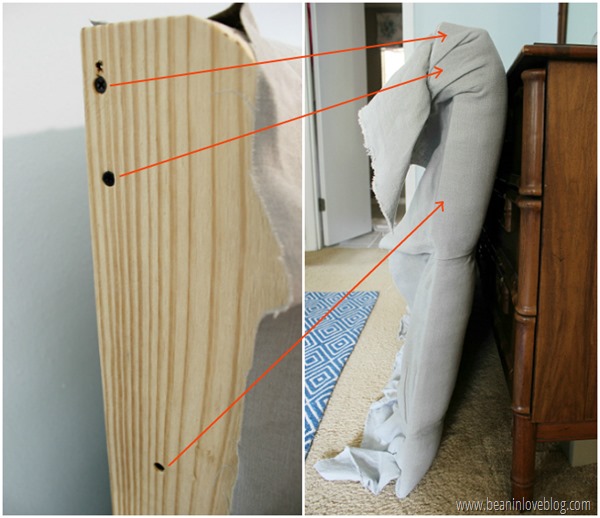
arm8
Next, we finished wrapping the fabric around the front and outside of each arm, stapling at the back.IMG_7918
IMG_7919
Now it gets a little tricky with the design at the top.  To polish off this part, Ifirst folded down the excess fabric at the top of each arm and stapled it to the back.
arm9

The arms now looked like this:
IMG_7925

Then, I trimmed away the fabric around the design, making sure there was an inch of excess above and beyond the top of the design.IMG_7926

The fabric had to be wrapped onto the design but because of the curves, I had to cut notches around each curve and corner so it could be folded nicely.  So, I basically cut triangles with the points almost touching the wood of the arm around each curve and into each corner.  I made sure I cut the triangle points deep enough that they’d allow the fabric to be folded without being pulled but not too deep that they went into the side of the arm, exposing the wood beneath.
IMG_7927

Next, Anthony helped me staple each flap around the curves down – I held them down tightly and he stapled.  (Tip:  If a staple doesn’t go in perfectly; if it sticks out a little, just grab a hammer and hammer it flat.)
arm10

The last thing I needed to do to finish off the arms was to make a strip of fabric to cover the front of each.  To make these strips, I cut out two long, narrow rectangles out of what was left of the fabric we used to wrap the arms in.  The front of each arm measured 2.5 inches wide so I cut the rectangles to be 4.5 inches wide so that I could have a finished, one-inch hem on each side.  Length-wise, I cut them so that I had plenty of fabric left to be able to fold it over and under the tops and bottoms of each arm.  That made them about 70 inches long.

Using my quilting square* was super helpful in making sure I was measuring and cutting straight edges.  I drew four lines onto what would be my strips of fabric – two the width of the entire strip pre-hem to show where to cut them out of the fabric remnant and two where I’d fold to make the hem.IMG_7932

To finish the strips, I used no-sew, iron-on hem tape*.  I placed the hem tape on the inside of the fold line on one side, ironed it, and did the same to the other side.   
arm11

To get the strip on its arm, I first cut a small piece of hem tape a little shorter than the width of the front of the arm, placed it at the top of the arm, and ironed on the strip of fabric so that it was secured by the hem tape.
IMG_7939

IMG_7940
I wanted to glue most of the strip on because I wasn’t sure I had enough hem tape to iron it on so by placing that small piece of iron-on tape at the top, the strip was held in place and allowed the glue I used to dry without moving.  I did the same thing with a small piece of iron-on tape to the flat part between the two curves of the design at the top of each arm and also placed one right below the second curve; right on the front, flat part of the arm.

To glue the strips on, I ran two small lines of glue down the middle sides of each side of the front of the arm like so:IMG_7941(I used this fabric glue but any craft glue and even hot glue will work.  Hot glue just requires a lot of careful gluing so it doesn’t get on the fabric where it’d be tough to remove.)

I did it this way all the way down.  There was extra fabric at the bottom of the arms that we just folded under the arm – I folded under while Anthony held the headboard off the ground.  One day, when we move and have to take the bed apart, we’ll staple them down but until then, no one will ever know they’re not secured underneath so shhhhh…

Ta-daaaaa!  That is IT!

IMG_7986
It cost us a little under $100 to make this headboard and if we’d have had to buy the foam for it, it would still only have rung in at around $130.  Not too shabby, eh?  Not too shabby at all.  :D   

IMG_7988

Right after we finished it, I got really excited and quickly cranked out two new pillow covers for the euro pillows on the bed plus some matching faux roman shades that you might’ve noticed.  I stole the smaller square pillows from the living room to add some more color but really I’m still sulking over the fact that the fabric I wanted to make covers out of for those costs $230 PER YARD.  No way Hosea.  It’s this orangerie floral by Designers Guild…
il_570xN.1034432595_iidn…and if I ever find a remnant that is majorly, and I mean majorly discounted, I will pounce.  Until then, I’ll forever (but hopefully not) be on the look-out for a similar print and pattern.

So, the headboard is done but what about the footboard?  Well, eventually I’d love to sand and restain it and I’m toying with the idea of upholstering and tufting the flat part in between the two posts but for now, there are bigger project fish to fry in this casa but don’t be suprised if that post pops up one day in the future.  

There are still a lot of things I want to get done in our room before we call it “done” – painting and adding legs to the nightstands, painting the dressers, painting or restaining our desk and bookshelf, hanging stuff on the walls, making a West Elm chandelier knock-off that I’ve had on the agenda for over a year now, blah, blah, blah…  Basically, the room will see it’s final state in a few years at the rate we move.  So it goes and so it is. 

But, now that I have a plush surface to sink my spine into when stress strikes, I don’t care how long it takes.  Slow and steady wins the home decor race…or maybe that’s just an excuse for decoristas with kids.  ;)

IMG_7985

Stay tuned for a quick post on how we attached this headboard to our existing, thrifted bed frame.

Adios.  :)

*Affiliate link to product we purchased or something similar to what we purchased to make this headboard.  If you click and buy, we will get a small commission.  Thank you for helping us keep the lights on around here!  :)

.           .           .

diy headboard

Fan Fail

(First and foremost, if you’ve been reading my writings for some time now you probably know that I usually post on Saturdays.  I’m switching that pattern up on y’all though and am going to start posting on Mondays with a few posts sprinkled in between due to family scheduling around here.  So, look for me at week’s beginning from now on!)

I tried something that’s been on my to-do list for awhile this week – updating the ceiling fan in our master with some sort of DIY light kit.  Success wasn’t on my side this week though so I’m considering the whole project a semi-fail.  But, I’m going to blab about it anyway just so you know it’s not all sunshine and roses, perfection and bliss over here when it comes to showcasing completed projects.  :)

So, at the beginning of the week, this is what our fan looked like:
fan 002 
Blah.  Thank the heavens it’s brass and not shiny gold but…blah.

Well, a couple of months ago I found this lamp shade on clearance at a local gem, Old Time Pottery, for $6 and thought it had great bones and once I put my crafty pants on, would look great hanging from any one of the boring ceiling fans in our house.  (I actually hung a shade from the ceiling fan in the girls’ room and love it, so I knew it could work.)
fan 001

The fabric however, had to go.  I could’ve just glued my new fabric right over the old but I was planning on using a white fabric that was a tad bit transparent and didn’t want the old fabric’s pattern showing through.  Also, as the old fabric was a darker color, it would’ve let less light through.  I removed it by running a seam ripper along the frame, bottom and top, in between the fabric and plastic lining. 
 fan 004

After that I was left with this: fan 005

The old fabric was glued to the plastic liner so all I did to remove that was gently pull.
 fan 007

Unfortunately, the plastic liner wasn’t as durable as I thought and when I first starting ripping at a corner, I tore it…boo.  Thankfully, the next step saved me…
 fan 008

The last change I made to the original shade was cutting it down a notch.  I simply made a bunch of marks two inches above the bottom (making sure I was cutting off the edge with the tear), drew a line, and cut.fan 009

And this is where things all went slightly downhill.  Before I started the reupholstering process, I wanted to make sure I had cut the shade down enough so I had Anthony hold it up to the fan for me.  It was then that I realized that with the  plastic being an off-white color and not white or clear, it looked a little dingy.  Had I planned on using a dark fabric for reupholstery it wouldn’t have mattered, but I wasn’t.  Dang.  To make a long story short, I searched Lowe’s, Home Depot, the internet, and finally some craft stores with zero luck.  The only stiff white or clear plastic I could find that was at least the 42 inches wide I needed it to be was on ebay for $49.99 a sheet.  Umm, “no thanks” said the chick.  “I’m cheep, cheep, cheep.”  So with the brainstorming help of a Hobby Lobby employee, I finally decided to see how a half yard of thick tablecloth vinyl would work.  Cost me $3.  What was there to lose, right?  Hmmm…

Back to work, I cut myself a piece of vinyl the same size as the original liner.
fan 011

And then I cut out my fabric…both layers.
fan 013

You see, I never make things easy for myself.  I used some leftover white lining fabric from our dining area valances on top of the clear vinyl but under the sheer portion of a patterned Target shower curtain I found at Dirt Cheap for $2.  I really liked the idea of the pattern on the shower curtain to be subtle, white on white, but ‘in yo face’ when the lights were on…you’ll see.

(Side note:  The next few pictures are bee ay dee.  Sorry.  They were taken after bedtime and under the soft-white (why do they call it soft white?  It’s yellowy/orange/ugly.) lighting of our dining room chandelier.)

fan 014

So after cutting both layers of fabric a smidge larger than my vinyl (1/2 inch on all sides), I grabbed some spray adhesive (Loctite from Walmart) and first sprayed the vinyl, attached the lining fabric, then sprayed the sheer fabric, and attached it to the lining.  You have to be really careful when you’re laying the fabric down on your adhesive that 1) it’s straight and 2) there aren’t any air bubbles/folds.  If you’re using a pattern like me, you also have to make sure it’s straight…read, pain in the butt but so worth it.  After my fabric was securely attached to the vinyl, I used hot glue to attach both short ends of fabric before gluing the tops and bottoms to the frame.
 fan 015

This is where, if you make a shade from scratch for yourself, you’ll need an extra set of hands to hold the frame while you glue.  It’s also where you’d need a whole ‘nother set of hands to take pictures…we didn’t have that luxury so I hope my explanation suffices.

While Anthony held both frames and the fabric-covered vinyl was laid out across our dining room table, I started at one end and glued small sections at a time, top and bottom.  Anthony rolled the frames along as I went.  As for how I situated the fabric and vinyl, the frame was set on the very edge of the vinyl and the fabric was folded right over  it and glued to the vinyl on the inside of the shade.  See?fan 016

[Update:  And then she finds this forgotten iPhone shot which she promptly adds.]
photo

Behold, the finished product:
 fan 018
But wait, I know what you’re thinking.  “It looks all wavy and stuff!"  I know, I almost cried.  So the vinyl wasn’t a great idea.  Because it’s not as stiff as real plastic, it rippled, therefore ruining my idea, therefore ruining my shade.  I tried to make sure it was nice and flat as we glued it to the frame but I guess it just wasn’t meant to be part of a lampshade. 

Here’s a closer look at the mess:
fan 019

Howeverrrr, the ripples aren’t noticeable at all when the light is on.
  fan 021

And see what I was talking about with the subtle pattern?fan 020
It’s hard to capture via camera but it’s looks so cool in person.  :)

At this point I was annoyed/frustrated/felt like I just wasted a ton of precious time.  I didn’t even feel like starting Part II…but just because I had a naptime and a crazy hair the next day, I did, just for kicks.

The large shade was not made to be alone.  No.  It was made for a smaller shade to complete it.  Namely, this one:fan 017
It was a Dirt Cheap find that only cost me a few bucks.

It had a white plastic liner and instead of cutting a new vinyl one (my original intention but seeing how the first turned out…), I just used the same process to attach, remove, and reupholster it as I did the larger shade, minus replacing the liner. 

After that was all done, I grabbed a couple of twisty-ties and attached the middle bars of each shade to each other like so: fan 022

Except when I went to hang the shade I realized the light bulb was too big to fit in between the two crossbars.  Enter the sign for Wits End with this project.  Sheesh…what next?

String?  No.  Fishing line?  We don’t have any………..  Paper clips?  Yes!
 fan 023

TA-DA!!
fan 025

Last, not wanting the view from below to be all wires and stuff, I cut out a piece of cardstock and stuck it to the bottom of the small shades frame with some sticky tack. 
fan 034
Once again, I know, it’s much too small and not any easier on the eyes.  I just haven’t gotten the chance to cut a larger circle but I think that should solve that problem.

So, ripples and all, here’s the finished product.
 fan 031

I’m definitely not in love with it and it definitely looks “homemade”, something I try to stray far from when DIYing home decor but for now, I’m going to live with it until I get another dose of motivation to switch it up or fix the large shade…speaking of, anyone have any recommendations on where to find some plastic lining?

fan 032  

I’ll be back sometime this week with details on what I’m thinking of whipping up next for this sorry fan and lots of other DIY light kit ideas, including where I got the inspiration for this shade.  Stay tuned!  It’s gonna to be good!

fan 030